How Cybersecurity Threats Are Changing for Small Businesses in 2026
Focus Keyword: Cybersecurity threats for small businesses
Introduction: Why Cybersecurity Is Becoming More Challenging for SMBs in 2026
Imagine arriving at work on Monday morning only to discover that your company’s customer database, financial records, employee files, and project documents are suddenly inaccessible. Your employees cannot log in. Your email accounts are behaving strangely. A message appears demanding payment to restore your files.
Your business has been hit by ransomware.
Now ask yourself: Could your business recover today?
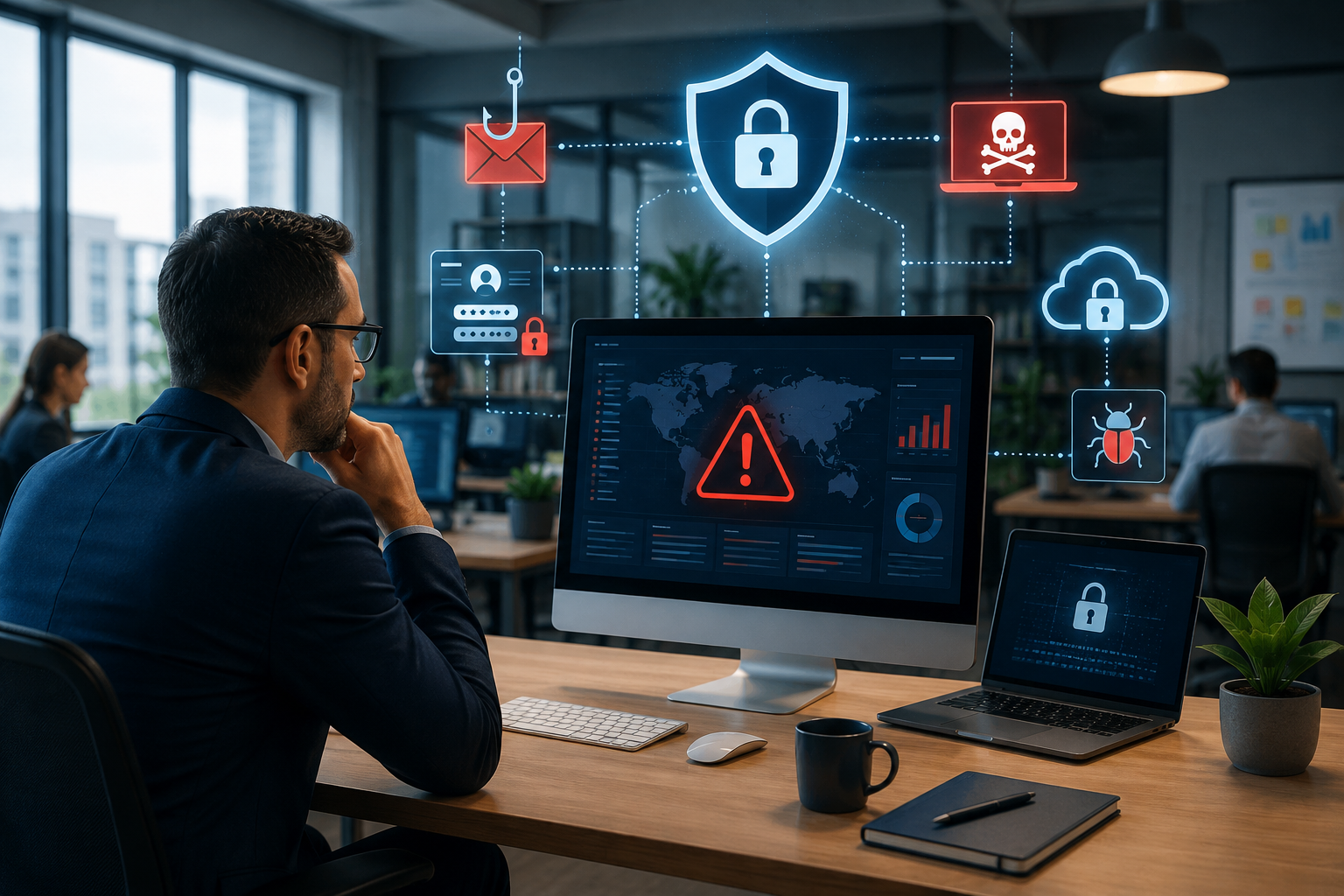
For many small and medium-sized businesses (SMBs), cybersecurity is no longer simply about installing antivirus software and telling employees not to open suspicious emails. The threat landscape has become more sophisticated, connected, and difficult to predict.
In 2026, cybercriminals are using artificial intelligence to create more convincing scams, exploiting unpatched software and exposed systems, targeting employee credentials, and taking advantage of weaknesses in cloud platforms and third-party vendors. The 2026 Verizon Data Breach Investigations Report provides current insights into these evolving threats and the challenges facing small and medium – sized businesses.
The good news is that businesses don’t have to wait for an attack to happen before taking action.
Understanding the latest cybersecurity threats for small businesses is the first step toward building stronger defenses, protecting sensitive information, and keeping operations running when something goes wrong. Businesses that need additional expertise can also explore IT security services designed to strengthen their overall security posture.
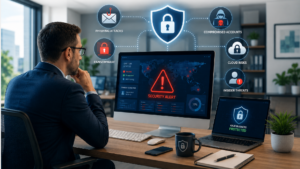
The Biggest Cybersecurity Threats Facing Small Businesses in 2026
Cyberattacks are constantly changing. Some familiar threats remain major concerns, while newer technologies are giving attackers faster and more convincing ways to target businesses.
Here are some of the most important threats SMBs should understand in 2026.
AI-Powered Phishing and Social Engineering
Phishing is not new, but it is becoming harder to recognize.
Attackers can now use AI to create professional-looking emails, messages, fake websites, and social engineering campaigns with fewer of the spelling mistakes and obvious warning signs people traditionally associated with scams.
An attacker might impersonate a company executive, vendor, customer, or financial institution and create an urgent request such as:
- “Please approve this invoice.”
- “Your Microsoft 365 account needs verification.”
- “I need this payment processed immediately.”
- “Review this document before our meeting.”
The Federal Trade Commission (FTC) warns that phishing messages can impersonate familiar people or businesses and use urgency to persuade employees to act quickly.
What has changed in 2026? The scam can look much more legitimate, making employee awareness and technical email protection increasingly important.
Ransomware
Ransomware remains one of the most damaging cybersecurity threats for small businesses.
Instead of simply locking files and demanding payment, modern ransomware attacks can involve stealing sensitive information before encrypting systems and then threatening to publish the stolen data.
The 2026 Verizon DBIR specifically notes that small organizations are disproportionately affected by ransomware.
A ransomware attack can affect much more than files. It can interrupt operations, delay customer service, prevent employees from working, create recovery expenses, and damage a company’s reputation.
Reliable backup and recovery solutions, endpoint protection, patching, employee training, and an incident response plan can significantly improve a business’s ability to withstand an attack.
Business Email Compromise
Business email compromise (BEC) occurs when criminals impersonate or compromise legitimate business accounts to trick employees into transferring money, changing payment information, or revealing sensitive information.
For example, an attacker could compromise an employee’s email account and send a convincing message to the accounting department requesting an urgent wire transfer.
The request may look completely normal.
That is why businesses should establish verification procedures for financial requests. For example, employees could be required to confirm unusual payment or account-change requests using a trusted phone number rather than replying to the original email.
Credential Theft and Account Takeovers
Passwords remain a valuable target because one compromised account can provide access to email, cloud applications, customer information, financial systems, and other business resources.
The 2026 Verizon DBIR reported that credentials appeared among compromised data in 31% of SMB breaches, while credential abuse accounted for 13% of initial access vectors in the SMB data.
Businesses should therefore treat identity security as a major part of cybersecurity—not simply a password issue.
Cloud and Microsoft 365 Security Threats
Moving business operations to the cloud provides significant benefits, but it does not automatically make a company secure.
Microsoft 365 accounts, cloud applications, shared files, and collaboration platforms can become valuable targets for attackers. A compromised cloud account may provide access to business email, documents, contacts, financial information, and other sensitive data.
Microsoft recommends layered security for Small and Medium -Sized Businesses (SMBs) including protection for email, collaboration applications, endpoints, identities, and business data.
Businesses should review cloud permissions, enable MFA, monitor account activity, and ensure that security settings are properly configured. Companies that rely heavily on cloud-based systems should also ensure their cloud solutions are properly secured and aligned with their business needs.
Endpoint and Device Vulnerabilities
Every laptop, desktop, smartphone, server, and other connected device represents another potential entry point.
A forgotten laptop that has not received security updates can become a weakness. So can an unsupported operating system, outdated application, poorly secured remote-access service, or unmanaged device.
This is especially important in 2026 because vulnerability exploitation has become a major concern. Verizon’s 2026 DBIR found that exploitation of vulnerabilities accounted for 26% of initial access vectors in SMB breaches.
Regular patching and endpoint protection should therefore be part of a business’s normal IT operations—not something done only after a security warning appears. For businesses without a dedicated IT team, managed IT services can help provide ongoing monitoring, maintenance, patch management, and security support.
Third-Party and Vendor Risks
Your business may have strong cybersecurity practices, but what about the companies you depend on?
Businesses increasingly rely on cloud providers, payment processors, software vendors, IT providers, contractors, and other third parties. If one of those organizations experiences a security incident, your business could potentially be affected.
The 2026 Verizon DBIR found third-party involvement in 55% of SMB breaches analyzed in its dataset.
That makes vendor security an important part of cybersecurity risk management.
Real-World Cybersecurity Scenarios for Small Businesses
Consider these everyday situations
Scenario 1: The fake invoice
An accounting employee receives what appears to be an email from a regular supplier. The supplier says its banking information has changed and asks the company to use a new account for the next payment.
The email is actually fraudulent.
Scenario 2: The compromised Microsoft 365 account
An employee enters their credentials into a convincing fake login page. The attacker obtains access to the account and uses it to read emails, search for financial information, and send convincing phishing messages to other employees.
Scenario 3: The unpatched server
A business delays an important software update because everything appears to be working normally. An attacker later exploits the vulnerability to gain access to the company’s environment.
These scenarios demonstrate an important point: cybersecurity threats for small businesses do not always begin with sophisticated hacking. Sometimes they begin with an overlooked update, a stolen password, or a convincing message.
Why Small Businesses Remain Attractive Targets
One of the most dangerous cybersecurity assumptions surrounding cybersecurity threats for small businesses is: “We’re too small to be targeted.”
Cybercriminals don’t necessarily choose victims because they are large or famous. Many attacks are opportunistic. Attackers look for exposed systems, compromised credentials, vulnerable software, and businesses that may have limited security resources.
The 2026 Verizon DBIR recorded 7,256 incidents involving small organizations, with 7,152 having confirmed data disclosure in its dataset. It also found that external actors were responsible for 100% of the breaches in the SMB category analyzed.
For a small business, a successful attack can have an outsized impact because there may be fewer employees, fewer technical resources, and less operational redundancy available to absorb the disruption.
Common Cybersecurity Mistakes SMBs Make
Many security incidents involving cybersecurity threats for small businesses can be traced to basic weaknesses that organizations sometimes overlook. Common mistakes include:
- Using weak or reused passwords across multiple accounts.
- Not enabling multi-factor authentication (MFA) on important systems.
- Delaying software updates and security patches.
- Providing inadequate employee security awareness training.
- Giving employees more access than they actually need.
- Failing to maintain reliable, tested backups.
- Having no documented incident response plan.
- Ignoring third-party and vendor security risks.
- Failing to monitor systems for suspicious activity.
CISA recommends that SMBs prioritize practices such as strong passwords, MFA, software updates, logging, data backups, encryption, and employee phishing awareness. CISA’s Small and Medium-Sized Business Resources provides additional guidance and practical resources for business looking to strengthen their cybersecurity awareness
Practical Cybersecurity Measures Businesses Should Implement
Protecting a small business from today’s cybersecurity threats doesn’t have to mean implementing every security technology available. Start with the fundamentals and build from there.
Enable Multi-Factor Authentication
MFA adds another verification step beyond a password. Even if a password is stolen, MFA can make it significantly harder for an attacker to access the account.
Prioritize email, cloud applications, administrator accounts, remote access, and other systems containing sensitive information.
Provide Employee Security Awareness Training
Employees are an important part of your security strategy.
Train employees to recognize:
- Phishing emails
- Suspicious links and attachments
- Fake login pages
- Social engineering
- Business email scams
- Unusual payment requests
- Impersonation attempts
Training should be ongoing because attack techniques continue to change.
Use Endpoint Protection
Protect laptops, desktops, servers, and other business devices with appropriate endpoint security controls.
Endpoint protection can help detect malicious activity and reduce the likelihood that one compromised device becomes a larger business-wide incident.
Keep Systems and Software Updated
Don’t ignore security updates.
Establish a regular process for updating operating systems, applications, browsers, network equipment, and other business technology.
Implement Strong Access Controls
Employees should only have access to the information and systems necessary for their responsibilities.
Review user accounts regularly and remove access when employees leave the company or change roles.
Maintain Backups and Recovery
Backups are an essential part of cybersecurity and business continuity.
Important business data should be backed up regularly, protected from unauthorized access, and periodically tested to make sure it can actually be restored.
The Federal Trade Commission (FTC) recommends regular backups as part of protecting small businesses against ransomware and other cyberattacks.
Monitor Systems for Suspicious Activity
Prevention is important, but businesses also need to know when something unusual is happening.
Security monitoring and logging can help identify suspicious logins, unexpected changes, unusual network activity, and other warning signs. CISA specifically recommends logging and monitoring business systems to help detect malicious activity.
Why Proactive Cybersecurity Matters
Waiting until something goes wrong is an expensive way to manage cybersecurity.
A proactive approach to cybersecurity threats for small businesses focuses on identifying weaknesses before attackers find them. It combines technology, policies, employee awareness, monitoring, backups, and regular security reviews.
For SMBs without a dedicated IT security team, proactive managed IT services can provide ongoing visibility into areas that are easy to overlook.
The goal isn’t to guarantee that an attack will never happen. No security strategy can make that promise.
The goal is to reduce risk, detect threats earlier, limit damage, and recover faster.
When Should a Business Consider Professional IT Security Support?
Professional IT security support can be particularly valuable when:
-
- Your business doesn’t have a dedicated IT or cybersecurity team.
- Employees work remotely or across multiple locations.
- You manage sensitive customer or financial information.
- Your company relies heavily on Microsoft 365 or cloud applications.
- You don’t know whether your systems are fully patched.
- You aren’t sure who has access to critical business systems.
- You don’t have reliable security monitoring.
- You don’t have an incident response plan.
- Your business has experienced a security incident or suspicious activity.
- Your internal team doesn’t have the time or expertise to manage cybersecurity consistently.
For many SMBs, professional IT security support can provide the expertise and ongoing oversight needed to move from reactive troubleshooting to proactive protection.
Frequently Asked Questions About Cybersecurity for Small Businesses
What are the biggest cybersecurity threats for small businesses in 2026?
Major threats include AI-enhanced phishing and social engineering, ransomware, business email compromise, credential theft, cloud account attacks, software vulnerabilities, endpoint threats, and third-party risks.
Why are small businesses targeted by cybercriminals?
Small businesses can have valuable data and access to financial systems while often having fewer cybersecurity resources than larger organizations. Attackers may also target businesses opportunistically based on exposed vulnerabilities or compromised credentials.
Is antivirus software enough to protect a small business?
No. Antivirus or endpoint protection is only one layer of a broader cybersecurity strategy. Businesses should also use MFA, strong access controls, employee training, patch management, backups, email security, and monitoring.
How can employees help prevent cyberattacks?
Employees can help by recognizing suspicious messages, avoiding unknown links and attachments, using secure passwords, following verification procedures for financial requests, reporting suspicious activity, and completing regular security awareness training.
Does moving to the cloud make a business more secure?
Not automatically. Cloud services can provide strong security capabilities, but those capabilities still need to be configured and managed properly. Businesses should review identity controls, permissions, MFA, data protection, and monitoring.
Should small businesses have an incident response plan?
Yes. An incident response plan establishes what the business should do if a cyberattack occurs, who is responsible for specific actions, and how systems and operations will be restored.
Conclusion: Don’t Wait for a Cyberattack to Test Your Security
The cybersecurity landscape has changed significantly, and cybersecurity threats for small businesses are becoming more sophisticated, targeted, and difficult to recognize.
AI-powered scams can make phishing messages more convincing. Ransomware can disrupt operations and expose sensitive information. Stolen credentials can give attackers access to critical accounts. Unpatched systems and third-party vendors can create additional pathways into your business.
But businesses don’t have to face these risks alone.
The most effective approach is proactive: protect your systems, train your employees, secure your accounts, keep technology updated, monitor for suspicious activity, maintain reliable backups, and have a plan for responding when something goes wrong.
If your business doesn’t have a dedicated IT security team or you’re not confident that your current security measures are keeping pace with today’s threats—Straten Solutions’ IT security services can help you strengthen your defenses and take a more proactive approach to cybersecurity. From IT security and managed services to cloud solutions, backup and recovery, and IT consulting, the right technology strategy can help protect your business while allowing you to focus on what you do best: running and growing your company.
Don’t wait for a cyberattack to reveal the gaps in your security. Start strengthening your business’s defenses today.